














Table of Contents
Get more resume writing tips, career insights, and workforce trends in your personalized search experience.
Is your resume up to par? How does it compare to other resumes from your industry? We’re here to help you find out.
After countless hours spent with our data science team, a couple weeks’ worth of sleepless nights, and a few double espressos too many—
We’re proud to present our hottest piece of state-of-the-art resume data so far.
We’ve analyzed data from over 133 thousand documents created in our builder. We wanted to see what candidates across the most popular professions write about their job histories, career objectives, and skills.
Plus, we aimed to find out how today’s job seekers approach their job hunt. What are the keywords they use to describe their expertise? How long are their resumes? How many different versions of a resume each user creates?
The data we’re presenting concerns three key characteristics of resumes created by candidates in different fields.
Key resume features analyzed
1. Sections used
What “typical” resume sections (Personal Information, Resume Objective/Resume Summary, Work History, Education, Skills, Certifications, Languages, Software, etc.) candidates in a given field use.
2. The most common skills
The lists of the most common skills feature singular skill items entered in the “Skills,” “Software,” or “Certifications” sections.
3. The most important resume keywords
Finally, we analyzed all words used by candidates on their resumes to and applied the TF*IDF (short for term frequency—inverse document frequency) statistic to identify the most profession-relevant keywords used by candidates in a given field. We ran separate analyses for nouns, verbs, and adjectives.
The data presented below is divided into general data extracted from all downloaded resumes and specific data from resumes for 10 most common professions.
What we learned about all resumes (and how you can use it to boost your job search)
First, let’s discuss what an average resume for a job created in 2022 looks like. (Spoiler alert: job seekers tend to make fundamental mistakes you can avoid to outperform most of your competition with little effort).
Resume length
- Average resume length: 489 words (standard deviation of 310 words)
- Median resume length: 369 words
Distribution (limited to resumes no longer than 1000 words):
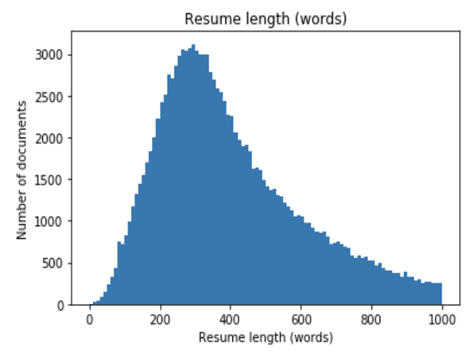
For a typical resume created in our builder, about 380 words is the single-page cut off point. The data clearly shows that an average user tries to keep her resume one page long.
Is this the ideal strategy, though? Nope, not at all.
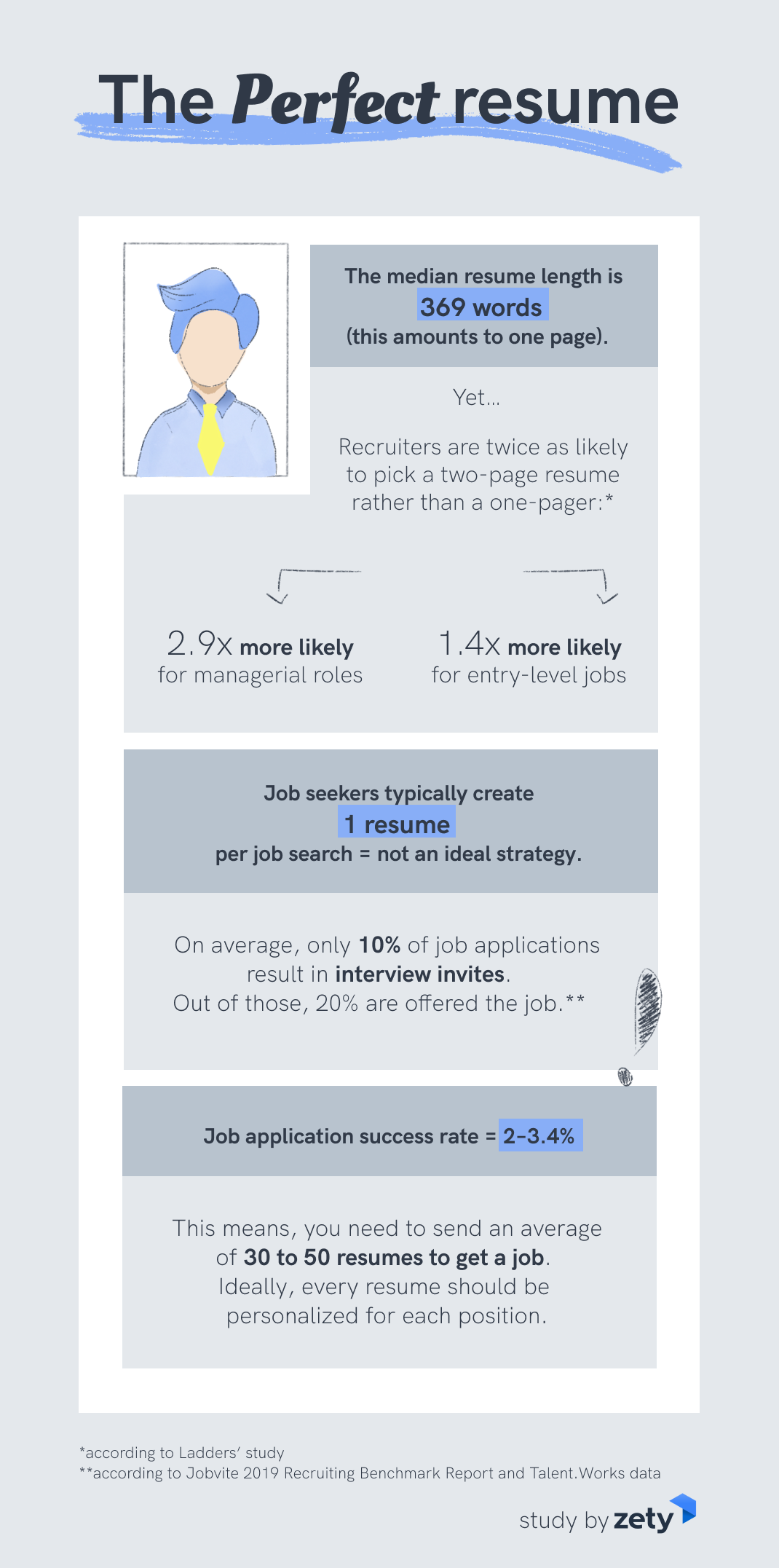
Contrary to the popular belief, nowadays recruiters prefer two-page resumes. Data shows that recruiters are 2.9x more likely to pick a candidate with a two-page resume for managerial roles and 1.4x more likely for entry-level positions.What’s more, 77% of employers say seasoned workers should NOT use a single-page resume.The takeaway is simple: in 2022 and beyond, to boost your chances of scoring an interview, you should use a two-page resume. Especially if you’re an experienced professional. First of all, that’s what recruiters expect. Secondly, that’s what your competitors are not doing.
But this was not the worst resume sin we’ve discovered. Here’s the biggest, most common mistake most job seekers make:
How many resumes per user?
- Average: 1.73 resume per user
- Median: 1 resume per user
The statistics above are particularly worrying: the most effective job-hunting strategy is to customize each resume to match the requirements from the job ad (63% of recruiters want to receive resumes tailored to the open position). To do so, it’s advised to create a new resume for each job application. Yet—most users prefer to create one generic resume and send it with all job applications. Here’s why it’s such a grave mistake:
- On average, 10% of job applications result in interview invites.
- Out of those who land the interview, 20% are offered the job.
- Depending on the study, the job application success rate is between 2% and 3.4%.
- This means that, on average, you need to send between 30 and 50 resumes to get hired.
That said—Certain job seekers do create multiple resumes to fit the needs of various employers. Some take it to extreme: we’ve seen 17 users with over 100 resumes created. Our first thought? They’re using our tool to run their own resume-writing business and create documents for *their* clients. We checked. Not the case. All those resumes were written by users for their personal use—they just made minor tweaks and alterations in key skills and job duties described.
The user with the most resumes created 339 of them. Is this the exact approach we’re looking for when saying “tailor your resume to match the job ad?” Maybe not. Is it more effective than spamming the same resume around 300+ companies? A non-scientific guess: at least 10x more effective.
Fun fact: some two years ago, while running a preliminary analysis similar to the one we’re presenting here, we came across a user who “tailored” his resume to 500 jobs—all of those in Fortune500 companies. Can’t tell you if he landed the gig but we were in awe of his commitment.
So far, it’s not looking too good, right? Let’s dive into the actual contents of a typical resume.
What resume sections do job seekers use?
A vast majority of the users whose resumes we analyzed included the 5 main sections:
Standard, “must-have” resume sections:
- Personal Information: 99.85% of resumes
- Work Experience: 98.33%
- Education: 97.25%
- Skills: 89.81%
- Summary or Objective: 88.75%
Solid! What’s particularly heart-warming from a career expert’s perspective is how common the “Skills” section, as well as the heading statement (Summary or Objective) are.See, recruiters want to learn about your skills. In fact, not using a list of professional skills can hurt a resume as much as one year of unemployment. When it comes to the heading statement, despite the controversy, it’s best practice to use one—just don’t make it read like the old-school “career aim,” and focus it more on what you can bring to the table.
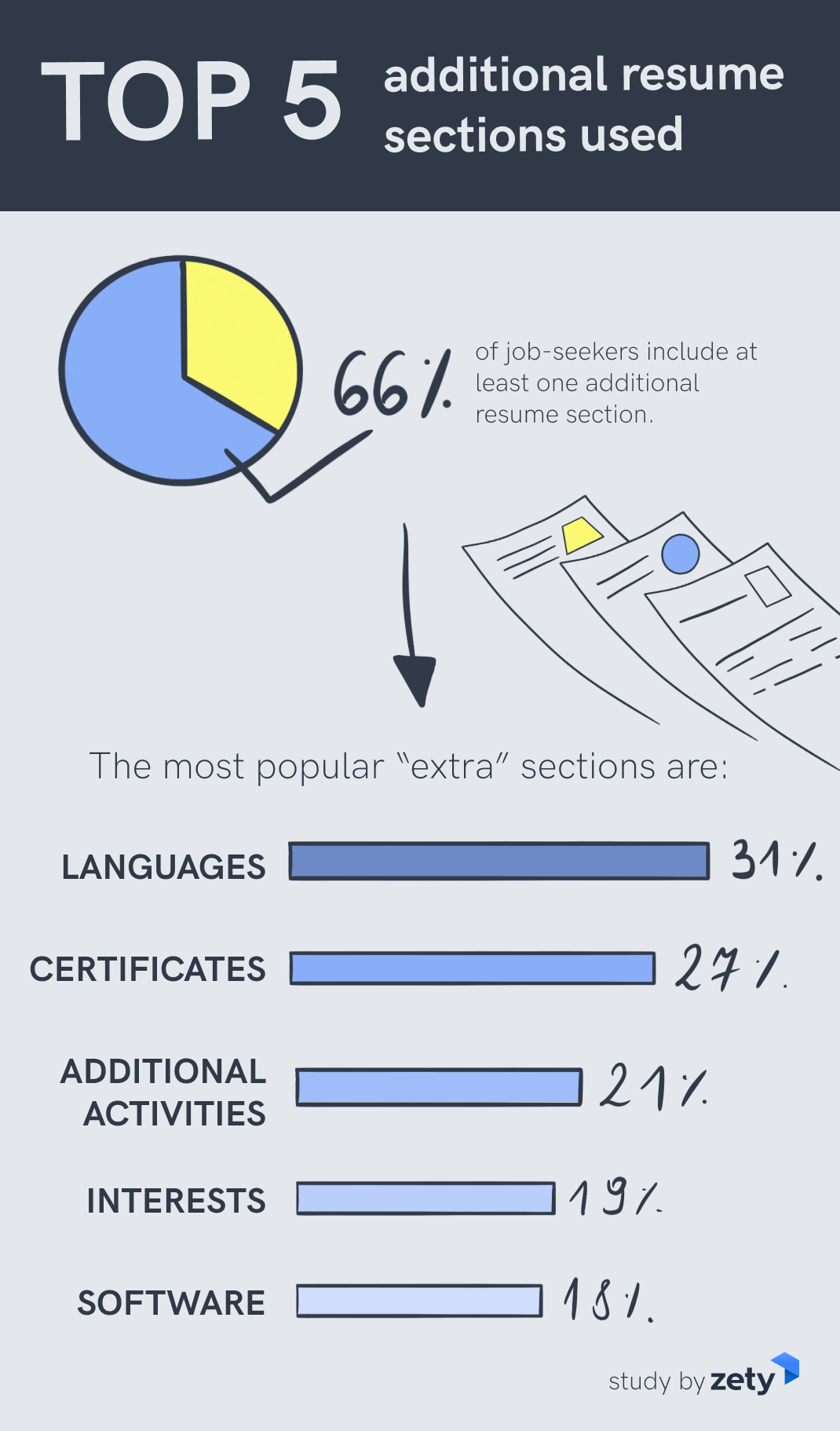
Also, contemporary job seekers don’t stop at “standard” resume sections. Most of them use at least one “additional” resume section to show they have an extra string in their bow.
The bottom line for you: in order to stand out from the crowd, use at least one or, ideally, a few additional sections in your resume to back up your qualifications).
Below you’ll see the most popular additional resume sections.
Additional sections:
- Any additional section: 66%
- Languages: 31%
- Certificates: 27%
- Additional Activities: 21%
- Interests: 19%
- Software: 18%
- References: 16%
- Courses: 11%
- Licenses: 5.5%
- Publications: 5.3%
- Conferences: 4.7%
- Legal Clause: 4.7%*
*In some countries, personal data processing regulations oblige job seekers to give prospective employers consent to having their data processed during recruitment.
Note that while certificates are the second most common “extra” section, only one in four job seekers lists them. And yet, it’s the single most verifiable way to prove your expertise. If you do have certifications, make sure to include them in a separate, prominent section on your resume. If you don’t, consider taking a certification course within your industry—this way, you’ll automatically be ahead of 73% of other job seekers.
Don’t have the time to get certified? Attend industry conferences and brag about it on a resume. Only 4.7% of job seekers list conference participation yet every recruiter will be interested to learn more about conferences you took part in (yes, you can list conferences in which you participated without giving a talk).
Finally, let’s look into the most common skills job seekers list on resumes.
Why is it important to you? Think about it this way: demand generates supply. If certain skills are used on resumes more often than others, it probably has something to do with recruiters expecting to see those skills.I’m not saying you should stuff your resume with whatever skills you see below. But if you feel you have those skills, do mention a few. Pay close attention to soft skills (“people” skills in particular) and don’t neglect basic software skills such as MS Office—you’d think proficiency in Microsoft’s products is implied and not worth mentioning on a resume yet it’s the gold standard and not listing it might make your job application look suspicious.
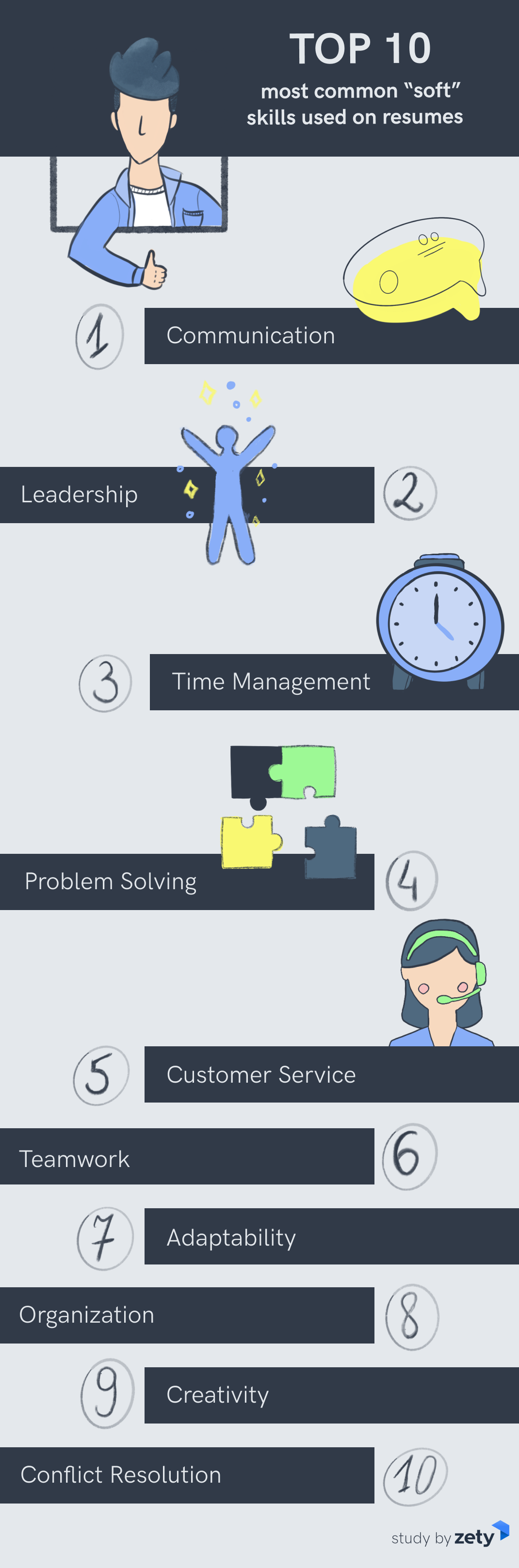
Top 10 most common “soft” skills listed in resumes
- Communication: 11% of resumes
- Leadership: 9%
- Time Management: 8%
- Problem Solving: 7%
- Customer Service: 5%
- Teamwork: 5%
- Adaptability: 4.3%
- Organization: 2%
- Creativity: 1.7%
- Conflict Resolution: 1.6%
Note: 5 out of 10 most common soft skills are typical “people skills:” communication, leadership, customer service, teamwork, and conflict resolution.
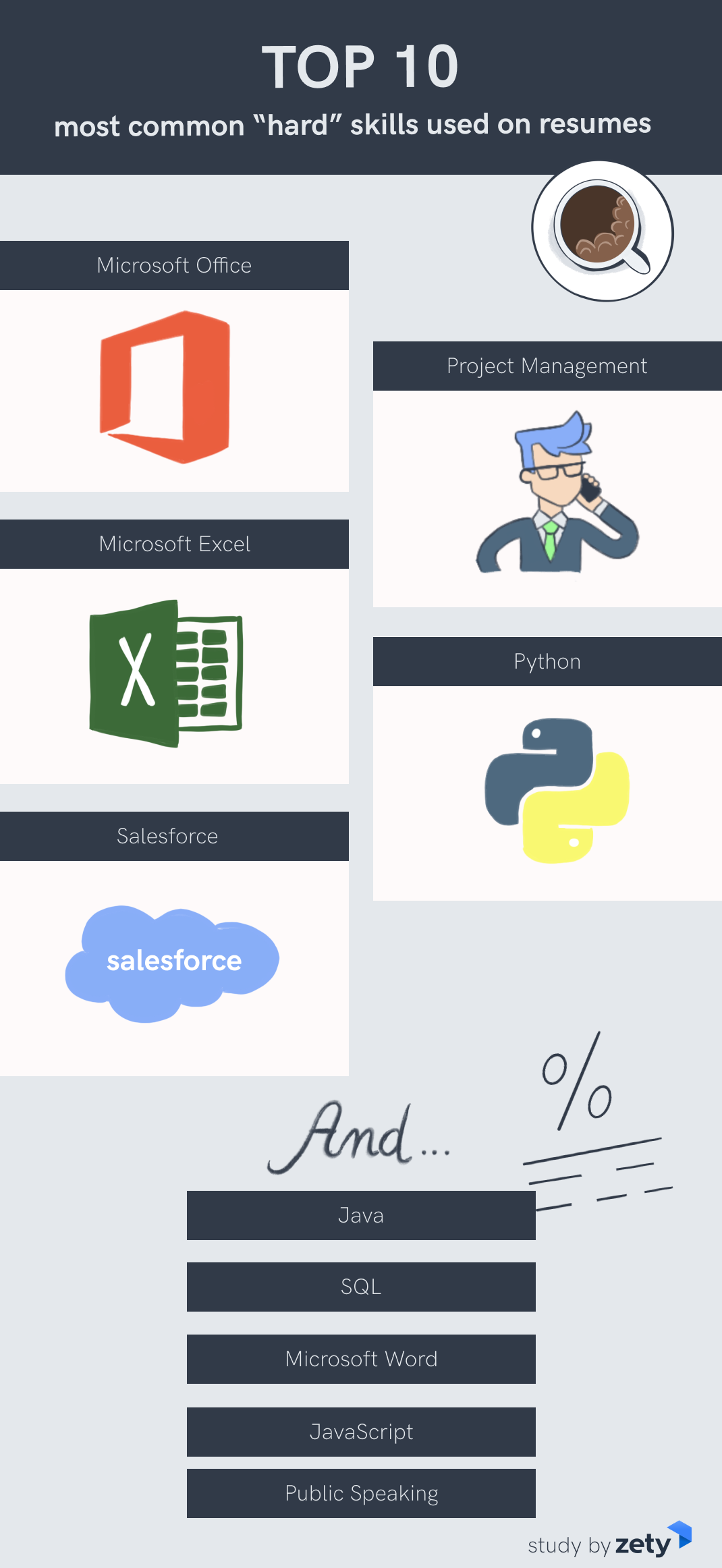
Top 10 most common “hard” skills listed in resumes
- Microsoft Office: 12% of resumes
- Project Management: 6%
- Microsoft Excel: 6%
- Python: 3.8%
- Salesforce: 3.6%
- Java: 3%
- SQL: 2.9%
- Microsoft Word: 2.7%
- JavaScript: 2.4%
- Public Speaking: 1.9%
Note: 8 out of 10 most common hard skills are specific software skills.
Top 10 most common foreign languages listed in resumes
- Spanish: 5.7% of resumes
- French: 4.1%
- Arabic: 3.6%
- Hindi: 2.9%
- German: 2.8%
- Russian: 1.5%
- Italian: 1.2%
- Portuguese: 1%
- Mandarin: 0.9%
- Tamil: 0.8%
Most Common Professions
- Software Engineer
- Administrative Assistant
- Project Manager
- Mechanical Engineer
- Customer Service
- Business Analyst
- Data Scientist
- Civil Engineer
- Accountant
- Product Manager
1. Software Engineer: 1720 resumes analyzed
Sections used
Standard, “must-have” resume sections:
- Personal information: 99.7% of resumes
- Work Experience: 99%
- Education: 98%
- Skills: 92%
- Summary or Objective: 86%
Additional sections:
- Any additional section: 70%
- Languages*: 34%
- (Additional) Activities: 29%
- Software: 24%
- Certificates: 22%
- Interests: 21%
- Courses: 10%
- References: 10%
- Publications: 6%
- Legal Clause: 6%
- Conferences: 3%
- Licenses: 2%
*The section “Languages” was used by candidates to describe either foreign languages or programming languages.
Top 15 most common skills
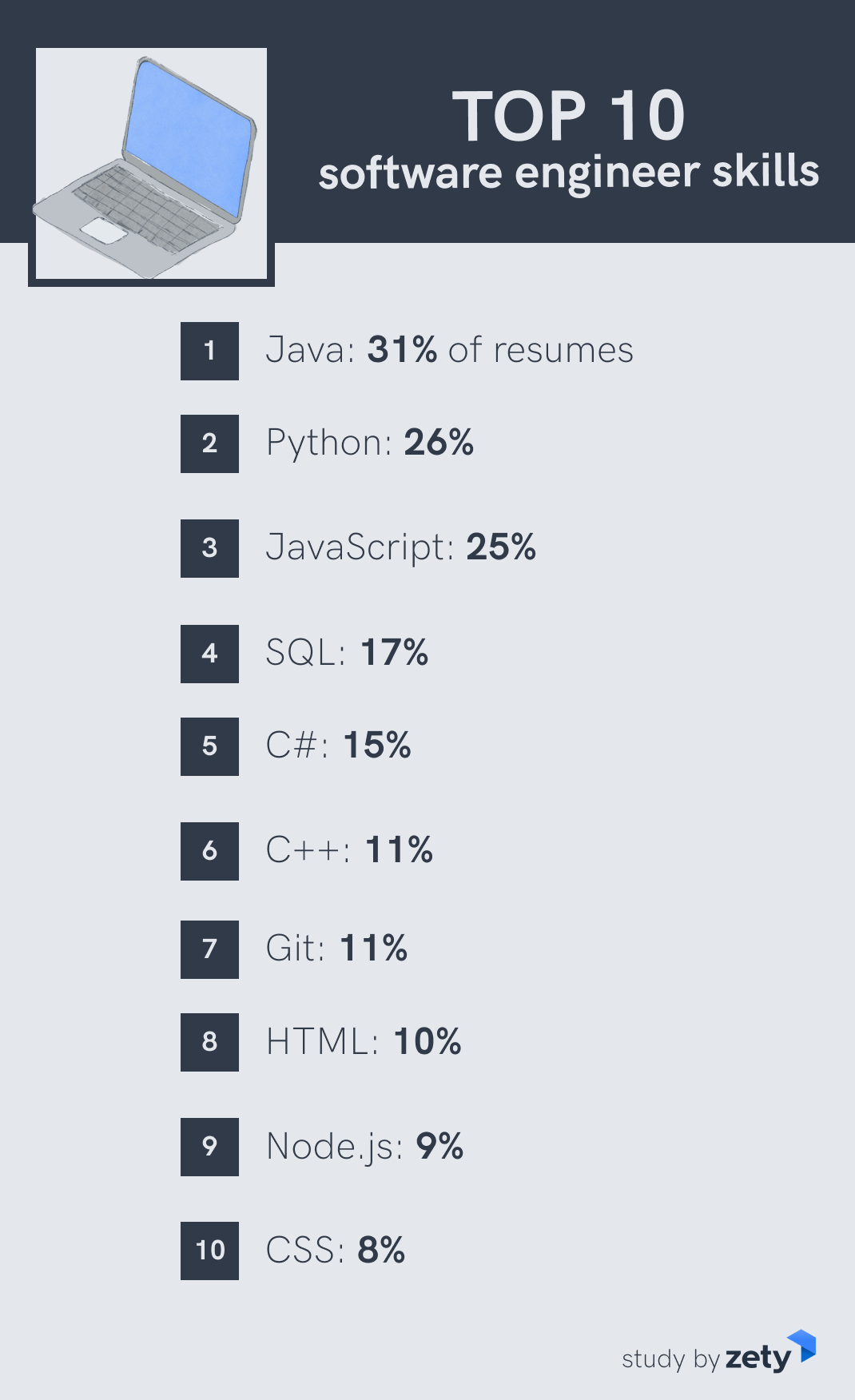
Unsurprisingly, the most common skills on software engineers’ resumes are almost entirely related to programming languages, presentation languages, or software systems. (With the exception of “English”—though it’s a language too!)
- Java: used on 530 resumes (31%)
- Python: 450 resumes (26%)
- JavaScript: 427 (25%)
- SQL: 297 (17%)
- C#: 256 (15%)
- C++ (only listed as a separate entry): 194 (11%)
- Git: 188 (11%)
- HTML: 170 (10%)
- Node.js: 147 (9%)
- CSS: 143 (8%)
- PHP: 126 (7%)
- C: 125 (7%)
- MySQL: 122 (7%)
- Docker: 120 (7%)
- AWS (or “Amazon Web Services”): 110 (6%)
Most important resume keywords: nouns, adjectives, and verbs
Nouns
| Keyword rank | Single-word noun | Two-word compound noun |
| 1 | Java | software engineer |
| 2 | Javascript | computer science |
| 3 | Python | HTML CSS |
| 4 | software | node js |
| 5 | SQL | SQL server |
| 6 | development | ASP.NET |
| 7 | system | software engineering |
| 8 | HTML | data structure |
| 9 | application | software development |
| 10 | Web | web development |
Adjectives
| Keyword rank | Single-word adjective | Two-word compound adjective |
| 1 | new | front end |
| 2 | English | web-based |
| 3 | technical | large scale |
| 4 | various | real-time |
| 5 | mobile | new technical |
| 6 | angular | responsible new |
| 7 | different | higher secondary |
| 8 | web | internal/external |
| 9 | multiple | cross-functional |
| 10 | visual | technical new |
Verbs
- using
- programming
- based
- developed
- worked
- testing
- learning
- designed
- implemented
- solving
2. Administrative Assistant: 1381 resumes analyzed
Sections used
Standard, “must-have” resume sections:
- Personal Information: 99.9%
- Work Experience: 99%
- Education: 97%
- Skills: 96%
- Summary or Objective: 93%
Additional resume sections:
- Any additional section: 37%
- Languages: 16%
- References: 12%
- Software: 10%
- Interests: 9%
- Certificates: 8%
- Additional Activities: 8%
- Courses: 4%
- Licenses: 2%
- Legal Clause: 2%
- Conferences: 1%
- Publications: 0.6%
Note: Only 37% of administrative assistant candidates used any “extra” section on their resume. If you’re looking for an admin assistant job, make sure you add value to your job application by listing certifications, courses, conference participation, or other additional activity. You’ll have an instant edge over most candidates.
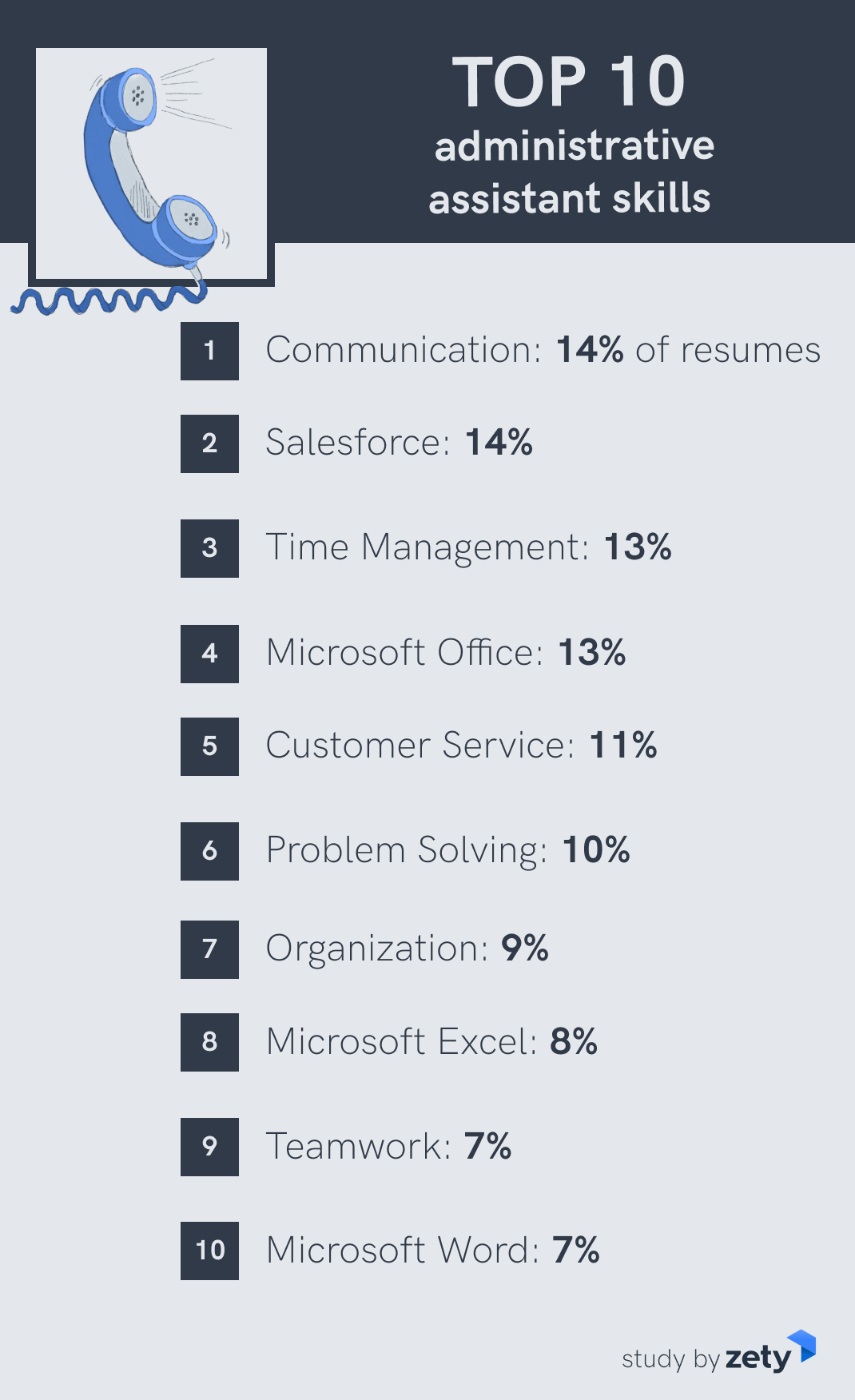
Top 15 most common skills
- Communication: 196 resumes (14%)
- Salesforce: 190 (14%)
- Time Management: 187 (13%)
- Microsoft Office: 186 (13%)
- Customer Service: 155 (11%)
- Problem Solving: 132 (10%)
- Organization: 126 (9%)
- Microsoft Excel: 114 (8%)
- Teamwork: 96 (7%)
- Microsoft Word: 95 (7%)
- Leadership: 91 (7%)
- Adaptability: 90 (7%)
- Computer Skills: 88 (6%)
- Multitasking: 78 (6%)
- Ability to Work Under Pressure: 55 (4%)
Most important resume keywords: nouns, adjectives, verbs
Nouns
| Keyword rank | Single-word noun | Two-word compound noun |
| 1 | skill | customer service |
| 2 | management | time management |
| 3 | customer | Microsoft Office |
| 4 | communication | communication skill |
| 5 | office | Microsoft Word |
| 6 | service | administrative assistant |
| 7 | Microsoft | year experience |
| 8 | assistant | high school |
| 9 | time | computer skill |
| 10 | Excel | data entry |
Adjectives
| Keyword rank | Single-word adjective | Two-word compound adjective |
| 1 | administrative | email administrative |
| 2 | new | proven email |
| 3 | high | retail-proven |
| 4 | excellent | payable/receivable |
| 5 | daily | fast-paced |
| 6 | strong | excellent verbal |
| 7 | professional | administrative multiple |
| 8 | social | corporate appointment |
| 9 | general | general appointment |
| 10 | various | internal/external |
Note: The TF*IDF algorithm we used to determine the most relevant keywords is programmed to identify patterns in word combinations while ignoring “stop” words (e.g. “or,” “a,”, “the,” “with,” etc.). That’s why certain compound adjectives seem weird or grammatically incorrect. “Administrative multiple,” might imply people who are responsible for “administrative [and] multiple [other tasks],” “internal/external,” might have been commonly used as part of the phrase “internal [and] external [communication].”
Verbs
- trained
- solving
- including
- working
- looking
- leverage
- maintained
- scheduling
- handling
- managed
3. Project Manager: 886 resumes analyzed
Sections used
Standard, “must-have” resume sections:
- Personal Information: 99.9% of resumes
- Work Experience: 99.9%
- Education: 97%
- Summary or Objective: 94%
- Skills: 93%
Additional resume sections:
- Any additional section: 70%
- Certificates: 36%
- Languages: 31%
- Software: 24%
- Additional Activities: 16%
- Interests: 15%
- Courses: 12%
- References: 11%
- Legal Clause: 5%
- Licenses: 5%
- Publications: 4%
- Conferences: 3%
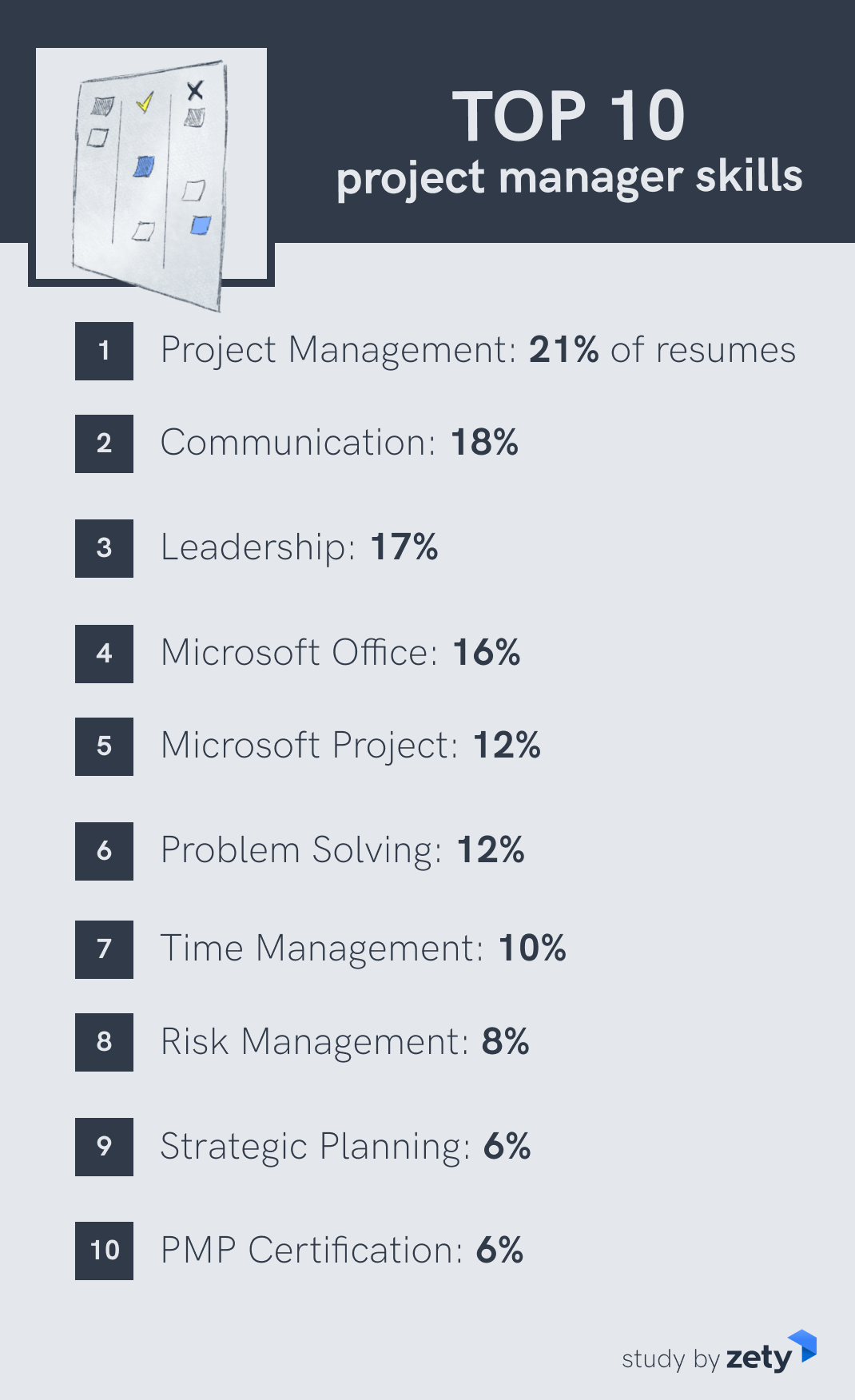
Top 15 most common skills
- Project Management: 187 (21%)
- Communication: 160 (18%)
- Leadership: 151 (17%)
- Microsoft Office: 146 (16%)
- Microsoft Project: 110 (12%)
- Problem Solving: 105 (12%)
- Time Management: 89 (10%)
- Risk Management: 68 (8%)
- Strategic Planning: 51 (6%)
- PMP Certification: 51 (6%)
- Salesforce: 42 (5%)
- Team Management: 42 (5%)
- Organization: 39 (4%)
- Negotiation: 38 (4%)
- Adaptability: 37 (4%)
Most important resume keywords: nouns, adjectives, verbs
Nouns
| Keyword rank | Single-word noun | Two-word compound noun |
| 1 | project | project management |
| 2 | management | Microsoft Office |
| 3 | team | project manager |
| 4 | communication | time management |
| 5 | Microsoft | Microsoft Project |
| 6 | business | risk management |
| 7 | leadership | communication skill |
| 8 | skill | management professional |
| 9 | manager | process improvement |
| 10 | office | customer service |
Note: Despite huge (and growing!) popularity of Atlassian products for workflow and project management (e.g. JIRA), it’s Microsoft’s project management software that made the lists of top skills and keywords on project managers’ resumes. The lesson? Don’t avoid talking about your expertise in Microsoft’s products. It seems the gold standard and its mastery is expected.
Adjectives
| Keyword rank | Single-word adjective | Two-word compound adjective |
| 1 | new | cross-functional |
| 2 | English | internal/external |
| 3 | technical | large-scale |
| 4 | multiple | weekly-monthly |
| 5 | various | on-site |
| 6 | responsible | responsible new |
| 7 | internal | on time |
| 8 | high | long-term |
| 9 | professional | excellent verbal |
| 10 | effective | technical new |
Verbs
- including
- managing
- solving
- planning
- working
- ensure
- using
- scheduling
- leading
- testing
4. Mechanical Engineer: 831 resumes analyzed
Sections used
Standard, “must-have” resume sections:
- Personal Information: 99.9%
- Education: 99.6%
- Work Experience: 98%
- Skills: 94%
- Summary or Objective: 91%
Additional resume sections:
- Any additional section: 85%
- Languages: 49%
- Software: 43%
- Certificates: 37%
- Additional Activities: 32%
- Interests: 31%
- References: 22%
- Courses: 22%
- Publications: 10%
- Licenses: 9%
- Conferences: 7%
- Legal Clause: 6%
Note: Mechanical engineers have the second highest usage of additional sections amongst the most popular professions, behind only civil engineers. At least one additional section was included in 85% of resumes from mechanical engineering candidates.
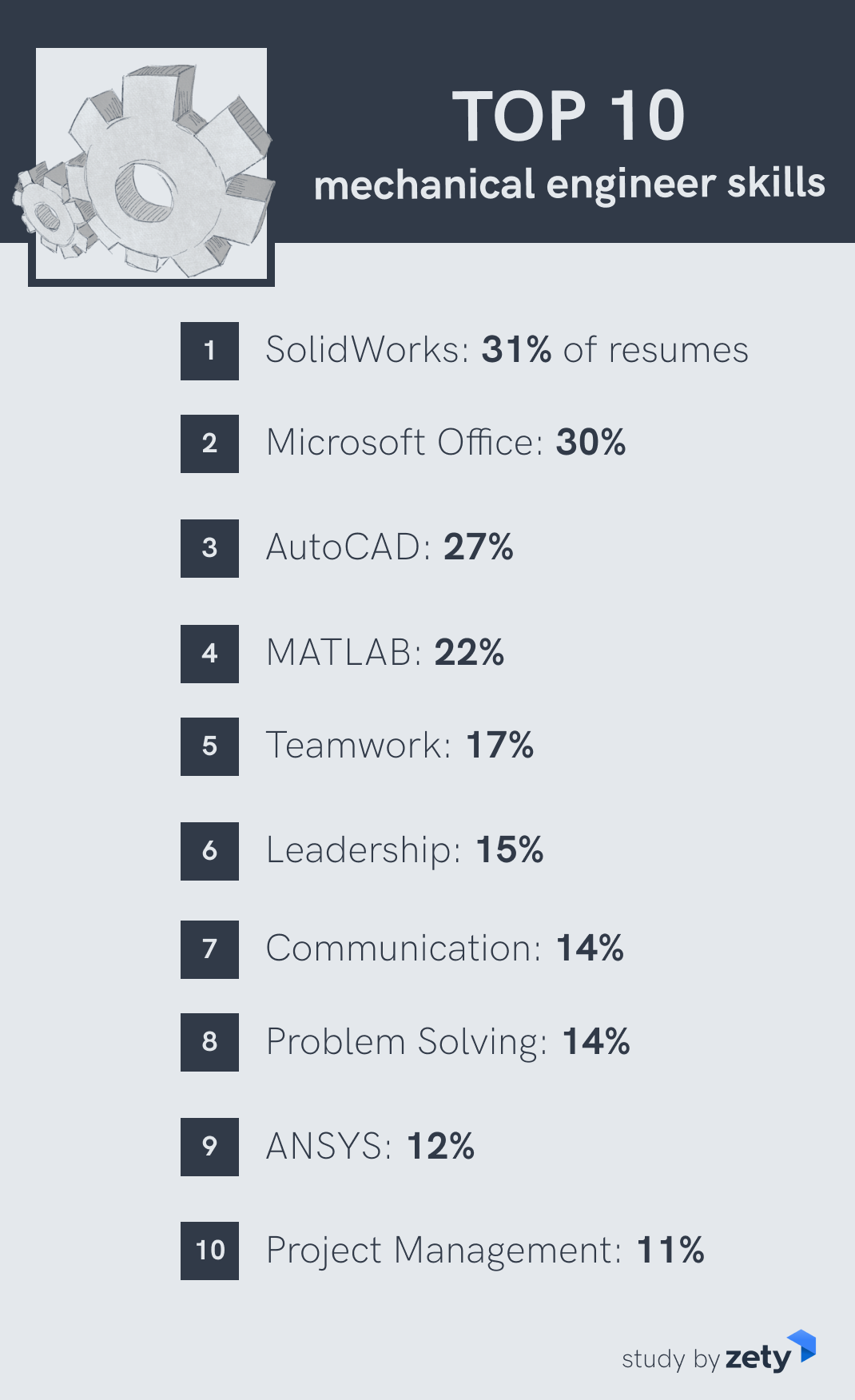
Top 15 most common skills
- SolidWorks: 260 (31%)
- Microsoft Office: 252 (30%)
- AutoCAD: 223 (27%)
- MATLAB: 179 (22%)
- Teamwork: 139 (17%)
- Leadership: 123 (15%)
- Communication: 115 (14%)
- Problem Solving: 113 (14%)
- ANSYS: 102 (12%)
- Project Management: 93 (11%)
- Time Management: 82 (10%)
- Microsoft Excel: 72 (9%)
- Adaptability: 41 (5%)
- Autodesk Inventor: 41 (5%)
- Microsoft Project: 40 (5%)
Most important resume keywords: nouns, adjectives, verbs
Nouns
| Keyword rank | Single-word noun | Two-word compound noun |
| 1 | SolidWorks | Microsoft Office |
| 2 | engineering | project management |
| 3 | design | mechanical engineering |
| 4 | project | time management |
| 5 | management | communication skill |
| 6 | AutoCAD | mechanical engineer |
| 7 | skill | Autodesk Inventor |
| 8 | office | CATIA V5 |
| 9 | mechanical | Team player |
| 10 | MATLAB | bachelor science |
Adjectives
| Keyword rank | Single-word adjective | Two-word compound adjective |
| 1 | English | true best |
| 2 | mechanical | higher secondary |
| 3 | technical | mechanical electrical |
| 4 | new | full-time |
| 5 | high | on-site |
| 6 | various | mechanical technical |
| 7 | different | cross-functional |
| 8 | Spanish | new technical |
| 9 | strong | technical mechanical |
| 10 | good | internal/external |
Verbs
- using
- solving
- working
- engineering
- designed
- testing
- programming
- manufacturing
- including
- completed
5. Customer Service Representative: 649 resumes analyzed
Sections used
Standard, “must-have” resume sections:
- Personal Information: 100%
- Work Experience: 99%
- Education: 96%
- Summary or Objective: 95%
- Skills: 94%
Additional resume sections:
- Any additional section: 37%
- Languages: 15%
- References: 15%
- Certificates: 9%
- Interests: 9%
- Software: 8%
- Additional Activities: 7%
- Courses: 3%
- Licenses: 1%
- Legal Clause: 1%
- Conferences: 0.3%
- Publications: 0.15%
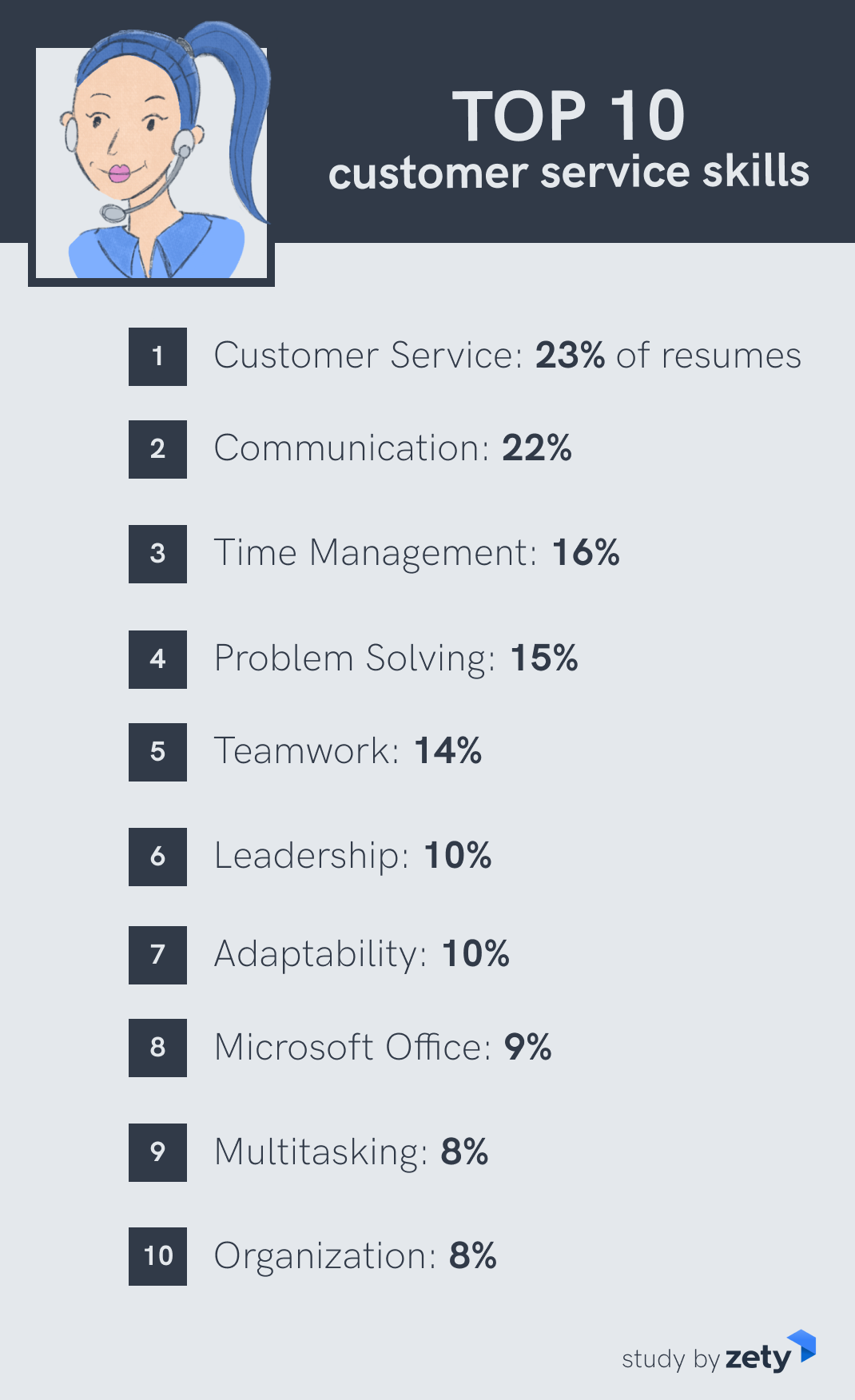
Top 15 most common skills
- Customer Service: 152 resumes (23%)
- Communication: 146 (22%)
- Time Management: 104 (16%)
- Problem Solving: 95 (15%)
- Teamwork: 89 (14%)
- Leadership: 64 (10%)
- Adaptability: 62 (10%)
- Microsoft Office: 61 (9%)
- Multitasking: 50 (8%)
- Organization: 52 (8%)
- Salesforce: 46 (7%)
- Microsoft Word: 43 (7%)
- Microsoft Excel: 41 (6%)
- Computer Skills: 34 (5%)
- Conflict Resolution: 33 (5%)
Most important resume keywords: nouns, adjectives, verbs
Nouns
| Keyword rank | Single-word noun | Two-word compound noun |
| 1 | customer | customer service |
| 2 | service | time management |
| 3 | communication | communication skill |
| 4 | skill | Microsoft Office |
| 5 | management | high school |
| 6 | problem | service representative |
| 7 | time | Microsoft Word |
| 8 | Microsoft | conflict resolution |
| 9 | sale | computer skill |
| 10 | school | years experience |
Adjectives
| Keyword rank | Single-word adjective | Two-word compound adjective |
| 1 | high | fast-paced |
| 2 | new | bilingual Spanish |
| 3 | excellent | internal/external |
| 4 | professional | excellent verbal |
| 5 | strong | full-time |
| 6 | English | excellent interpersonal |
| 7 | daily | responsible daily |
| 8 | Spanish | high new |
| 9 | positive | oriented professional |
| 10 | responsible | detail-oriented |
Verbs
- solving
- work
- oriented
- providing
- handling
- maintaining
- including
- ensure
- organized
- completed
6. Business Analyst: 391 resumes analyzed
Sections used
Standard, “must-have” resume sections:
- Personal Information: 100%
- Work Experience: 100%
- Education: 98%
- Skills: 97%
- Summary or Objective: 95%
Additional resume sections:
- Any additional section: 73%
- Certificates: 34%
- Software: 34%
- Languages: 28%
- Additional Activities: 20%
- Interests: 17%
- Courses: 14%
- References: 13%
- Publications: 6%
- Legal Clause: 6%
- Conferences: 4%
- Licenses: 2%
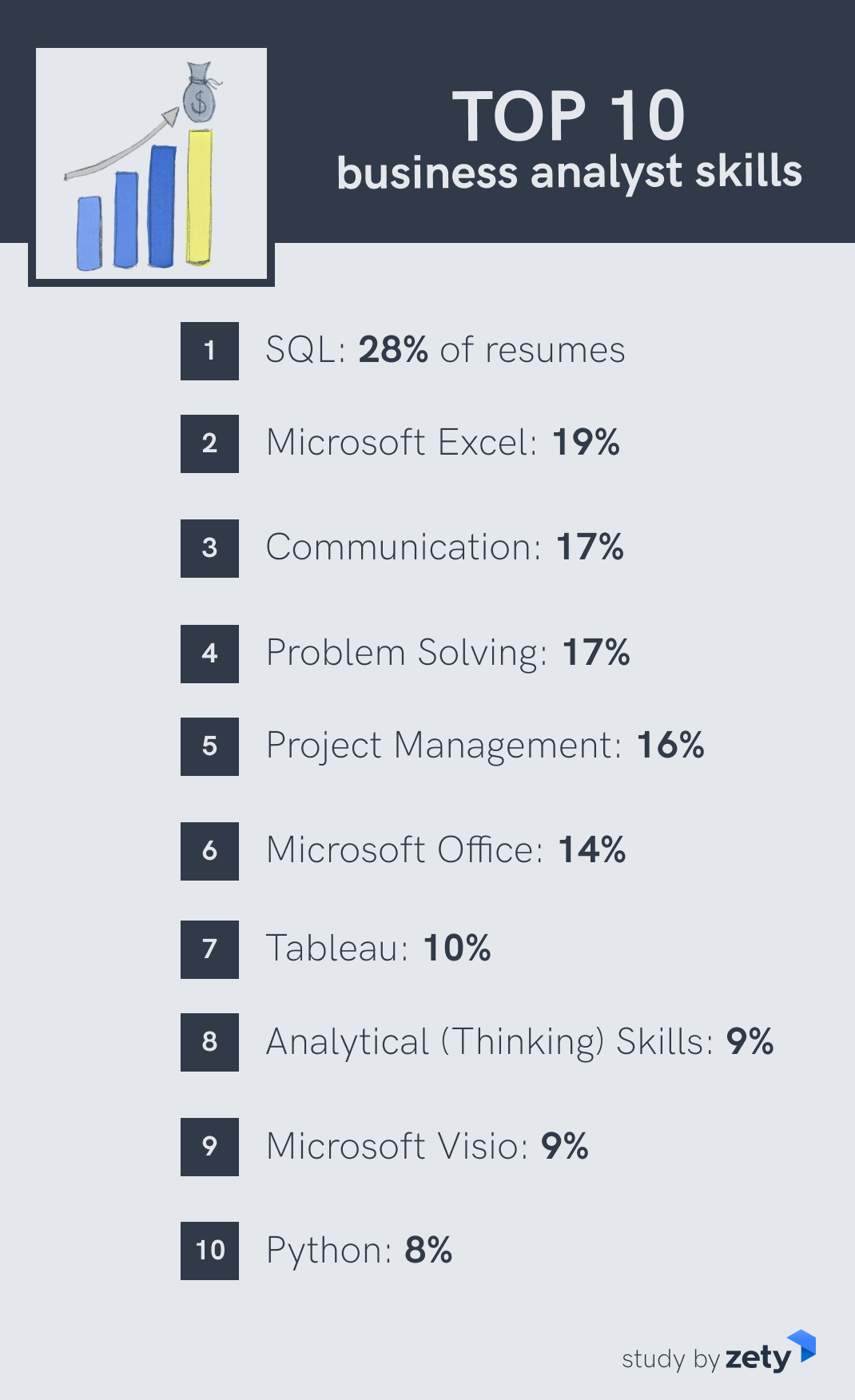
Top 15 most common skills
- SQL: 108 resumes (28%)
- Microsoft Excel: 73 (19%)
- Communication: 68 (17%)
- Problem Solving: 66 (17%)
- Project Management: 62 (16%)
- Microsoft Office: 53 (14%)
- Tableau: 41 (10%)
- Analytical (Thinking) Skills: 37 (9%)
- Microsoft Visio: 35 (9%)
- Python: 31 (8%)
- JIRA: 29 (7%)
- Business Analysis: 27 (7%)
- Process Improvement: 26 (7%)
- Teamwork: 23 (6%)
- Agile: 22 (6%)
Most important resume keywords: nouns, adjectives, verbs
Nouns
| Keyword rank | Single-word noun | Two-word compound noun |
| 1 | business | project management |
| 2 | management | business analyst |
| 3 | analysis | business analysis |
| 4 | project | microsoft office |
| 5 | data | communication skill |
| 6 | SQL | business process |
| 7 | skill | data analysis |
| 8 | Microsoft | Microsoft Excel |
| 9 | process | process improvement |
| 10 | requirement | time management |
Adjectives
| Keyword rank | Single-word adjective | Two-word compound adjective |
| 1 | new | cross-functional |
| 2 | technical | internal/external |
| 3 | English | functional technical |
| 4 | financial | strong analytical |
| 5 | functional | weekly/monthly |
| 6 | analytical | higher secondary |
| 7 | various | fast-paced |
| 8 | multiple | business strong |
| 9 | different | various new |
| 10 | effective | daily/weekly |
Verbs
- using
- solving
- testing
- working
- including
- based
- ensure
- reporting
- gathering
- creating
7. Data Scientist: 377 resumes analyzed
Sections used
Standard, “must-have” resume sections:
- Personal Information: 100%
- Work Experience: 99.7%
- Education: 99%
- Skills: 96%
- Summary or Objective: 89%
Additional resume sections:
- Any additional section: 80%
- Certificates: 36%
- Additional Activities: 35%
- Languages: 32%
- Software: 28%
- Interests: 20%
- Publications: 19%
- Courses: 15%
- References: 10%
- Conferences: 9%
- Legal Clause: 6%
- Licenses: 3%
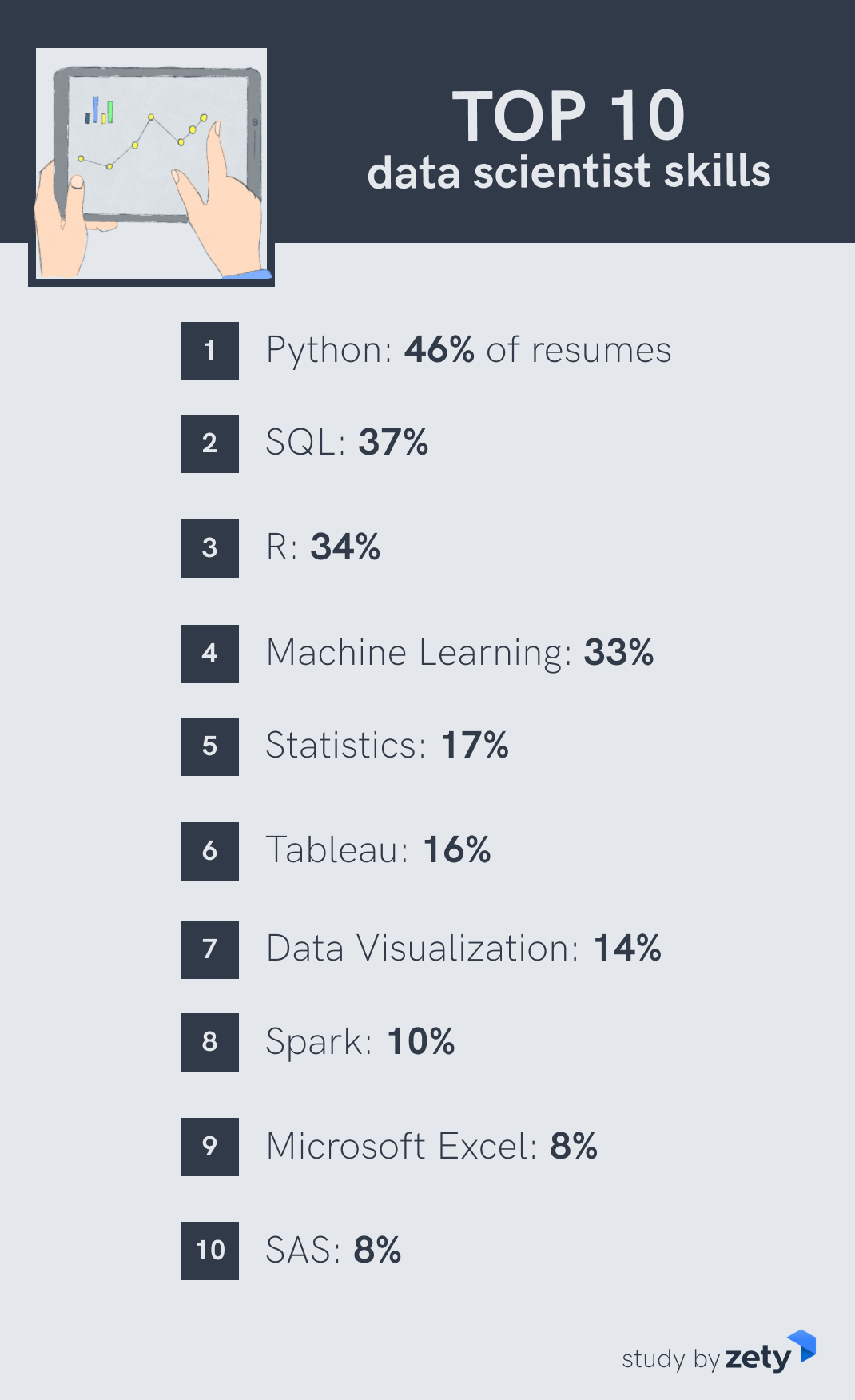
Top 15 most common skills
- Python: 174 resumes (46%)
- SQL: 141 (37%)
- R: 129 (34%)
- Machine Learning: 125 (33%)
- Statistics: 64 (17%)
- Tableau: 60 (16%)
- Data Visualization: 53 (14%)
- Spark: 37 (10%)
- Microsoft Excel: 31 (8%)
- SAS: 31 (8%)
- Deep Learning: 30 (8%)
- Java: 27 (7%)
- Data Analysis: 26 (7%)
- Problem Solving: 26 (7%)
- Natural Language Processing: 21 (6%)
Most important resume keywords: nouns, adjectives, verbs
Nouns
| Keyword rank | Single-word noun | Two-word compound noun |
| 1 | data | machine learning |
| 2 | Python | data science |
| 3 | machine | data visualization |
| 4 | SQL | deep learning |
| 5 | learning | data analysis |
| 6 | analysis | data scientist |
| 7 | science | big data |
| 8 | university | data mining |
| 9 | statistic | language processing |
| 10 | visualization | scikit-learn |
Adjectives
| Keyword rank | Single-word adjective | Two-word compound adjective |
| 1 | statistical | data driven |
| 2 | English | statistical predictive |
| 3 | predictive | convolutional neural |
| 4 | new | large-scale |
| 5 | various | cross-functional |
| 6 | different | internal/external |
| 7 | natural | predictive statistical |
| 8 | technical | demonstrated valuable |
| 9 | deep | quantitative qualitative |
| 10 | neural | random forest |
Verbs
- learning
- using
- based
- programming
- developed
- solving
- worked
- modeling
- working
- created
8. Civil Engineer: 356 resumes analyzed
Sections used
Standard, “must-have” resume sections:
- Personal Information: 99.7%
- Education: 99.7%
- Work Experience: 97%
- Skills: 92%
- Summary or Objective: 90%
Additional resume sections:
- Any additional section: 86%
- Languages: 63%
- Software: 42%
- Certificates: 39%
- Courses: 28%
- Additional Activities: 26%
- Interests: 24%
- References: 24%
- Licenses: 14%
- Conferences: 6%
- Publications: 6%
- Legal Clause: 6%
Note: Civil engineers have the highest usage of additional sections amongst the most popular professions. At least one additional section was included in 86% of resumes from civil engineering candidates.
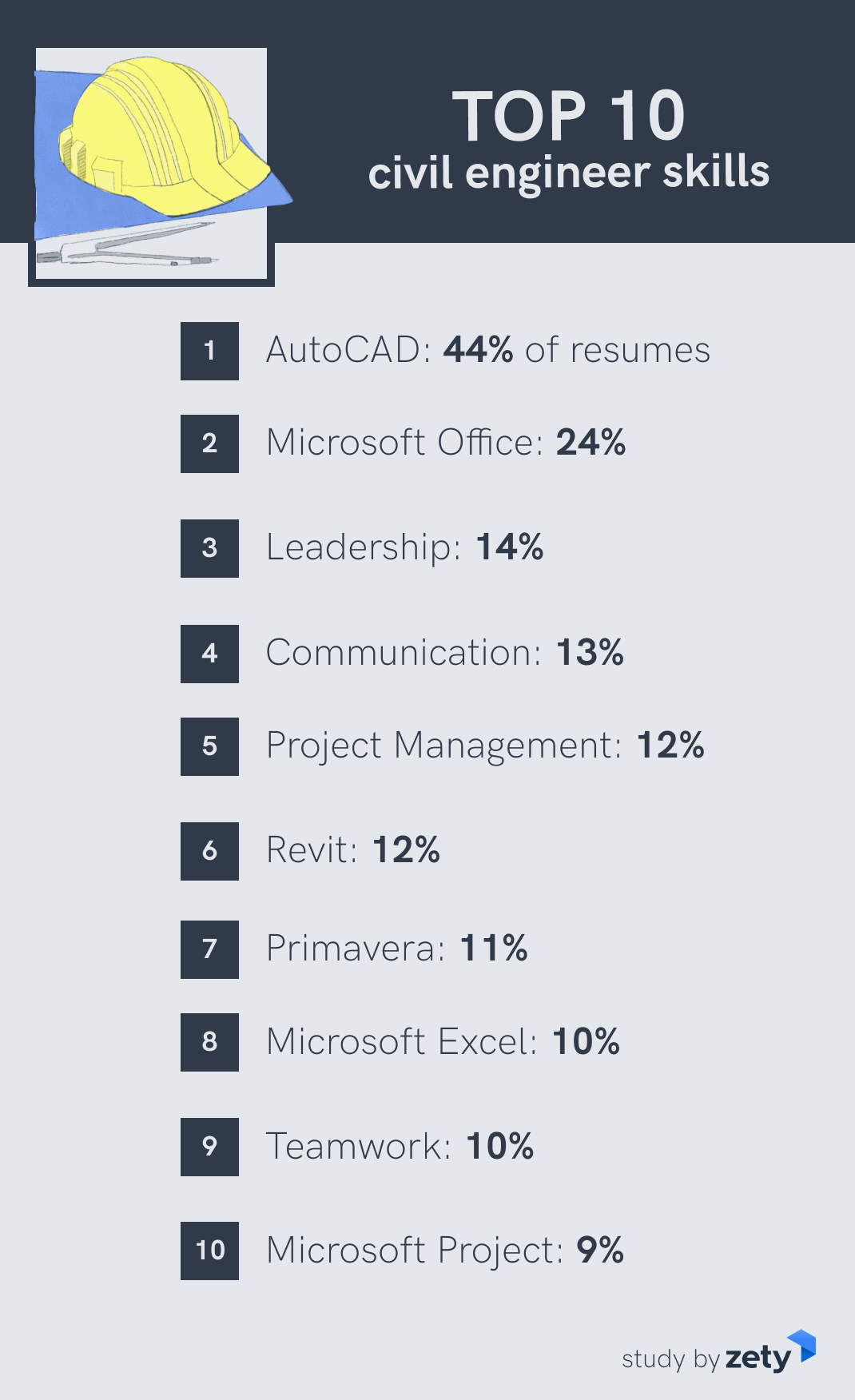
Top 15 most common skills
- AutoCAD: 156 (44%)
- Microsoft Office: 84 (24%)
- Leadership: 49 (14%)
- Communication: 46 (13%)
- Project Management: 44 (12%)
- Revit: 44 (12%)
- Primavera: 38 (11%)
- Microsoft Excel: 37 (10%)
- Teamwork: 34 (10%)
- Microsoft Project: 33 (9%)
- SAP2000: 29 (8%)
- Problem Solving: 27 (8%)
- Time Management: 21 (6%)
- ETABS: 18 (5%)
- Adaptability: 12 (3%)
Most important resume keywords: nouns, adjectives, verbs
Nouns
| Keyword rank | Single-word noun | Two-word compound noun |
| 1 | project | Microsoft Office |
| 2 | AutoCAD | project management |
| 3 | management | civil engineering |
| 4 | engineering | civil engineer |
| 5 | civil | communication skills |
| 6 | engineer | Primavera P6 |
| 7 | skill | time management |
| 8 | office | site engineer |
| 9 | construction | Microsoft Excel |
| 10 | design | Microsoft Project |
Adjectives
| Keyword rank | Single-word adjective | Two-word compound adjective |
| 1 | English | on-site |
| 2 | technical | autonomous high |
| 3 | civil | English good |
| 4 | structural | weekly/monthly |
| 5 | good | residential/commercial |
| 6 | new | higher secondary |
| 7 | concrete | daily/weekly |
| 8 | high | structural concrete |
| 9 | Spanish | daily/monthly |
| 10 | different | civil structural |
Verbs
- work
- using
- solving
- including
- engineering
- completed
- drawing
- surveying
- planning
- ensure
9. Accountant: 344 resumes analyzed
Sections used
Standard, “must-have” resume sections:
- Personal Information: 100%
- Education: 99%
- Work Experience: 98%
- Skills: 97%
- Summary or Objective: 90%
Additional resume sections:
- Any additional section: 65%
- Languages: 36%
- References: 21%
- Software: 19%
- Certificates: 19%
- Interests: 17%
- Courses: 14%
- Additional Activities: 11%
- Legal Clause: 5%
- Conferences: 4%
- Licenses: 3%
- Publications: 1.5%
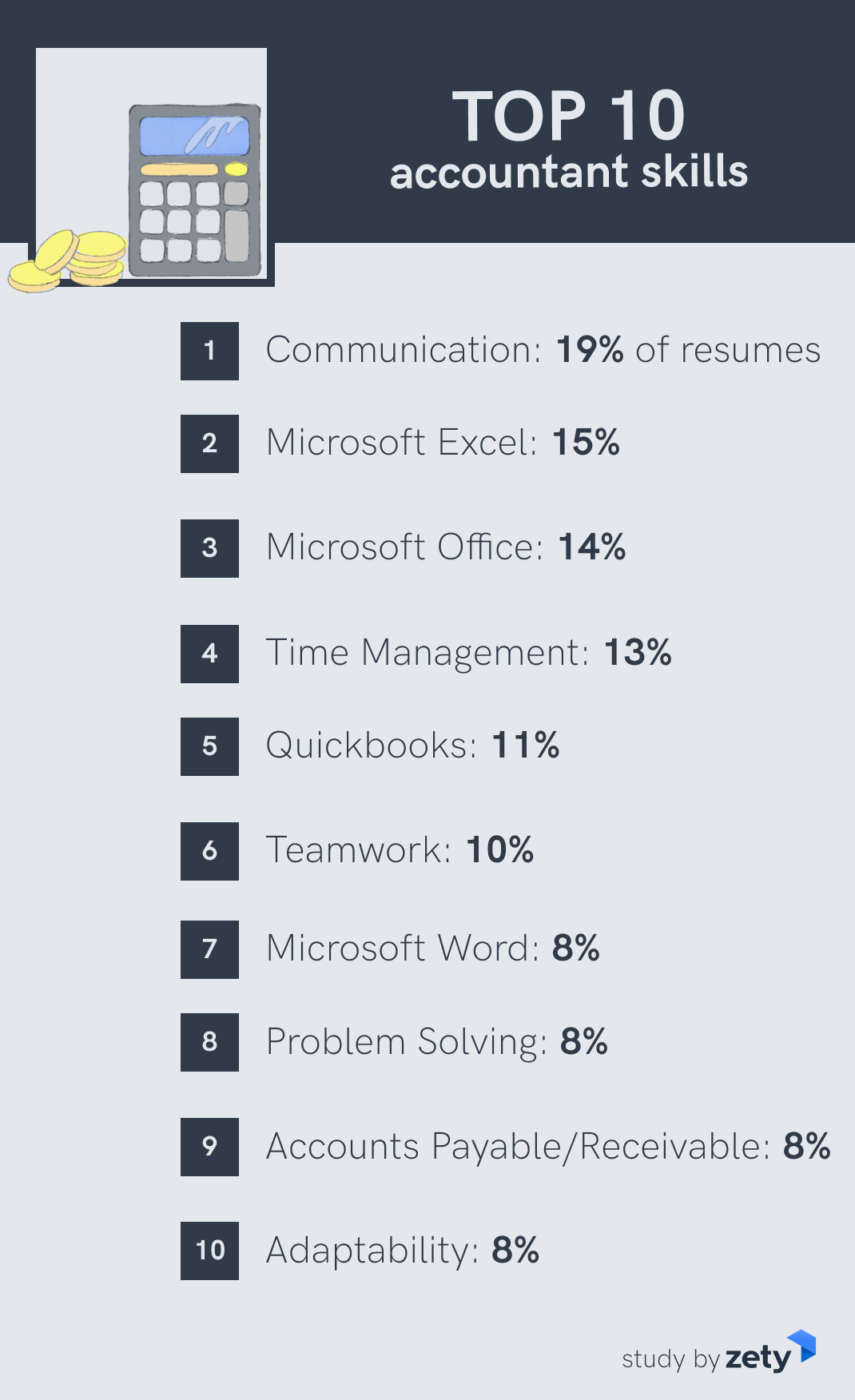
Top 15 most common skills:
- Communication: 67 (19%)
- Microsoft Excel: 53 (15%)
- Microsoft Office: 47 (14%)
- Time Management: 44 (13%)
- Quickbooks: 38 (11%)
- Teamwork: 35 (10%)
- Microsoft Word: 29 (8%)
- Problem Solving: 28 (8%)
- Accounts Payable/Receivable: 26 (8%)
- Adaptability: 26 (8%)
- Attention to Detail: 23 (7%)
- Financial Analysis: 19 (6%)
- Leadership: 18 (5%)
- SAP: 18 (5%)
- Analytical Skills: 15 (4%)
Most important resume keywords: nouns, adjectives, verbs
Nouns
| Keyword rank | Single-word noun | Two-word compound noun |
| 1 | accounting | time management |
| 2 | skill | communication skill |
| 3 | management | Microsoft Office |
| 4 | Microsoft | Microsoft Excel |
| 5 | communication | customer service |
| 6 | account | Microsoft Word |
| 7 | Excel | business administration |
| 8 | Office | accounting software |
| 9 | university | computer skill |
| 10 | accountant | years experience |
Adjectives
| Keyword rank | Single-word adjective | Two-word compound adjective |
| 1 | financial | payable/receivable |
| 2 | English | monthly financial |
| 3 | monthly | professional new |
| 4 | new | technical professional |
| 5 | payable | internal/external |
| 6 | professional | financial monthly |
| 7 | excellent | weekly/monthly |
| 8 | daily | excellent financial |
| 9 | good | excellent verbal |
| 10 | receivable | annual financial |
Verbs
- including
- work
- accounting
- solving
- oriented
- ensure
- organized
- preparing
- reporting
- seeking
10. Product Manager: 344 resumes analyzed
Sections used
Standard, “must-have” resume sections:
- Work Experience: 100%
- Personal Information: 99.7%
- Education: 96%
- Skills: 91%
- Summary or Objective: 90%
Additional resume sections:
- Any additional section: 75%
- Certificates: 36%
- Software: 31%
- Languages: 29%
- Interests: 22%
- Additional Activities: 22%
- Courses: 10%
- References: 8%
- Publications: 8%
- Conferences: 6%
- Licenses: 2%
- Legal Clause: 2%
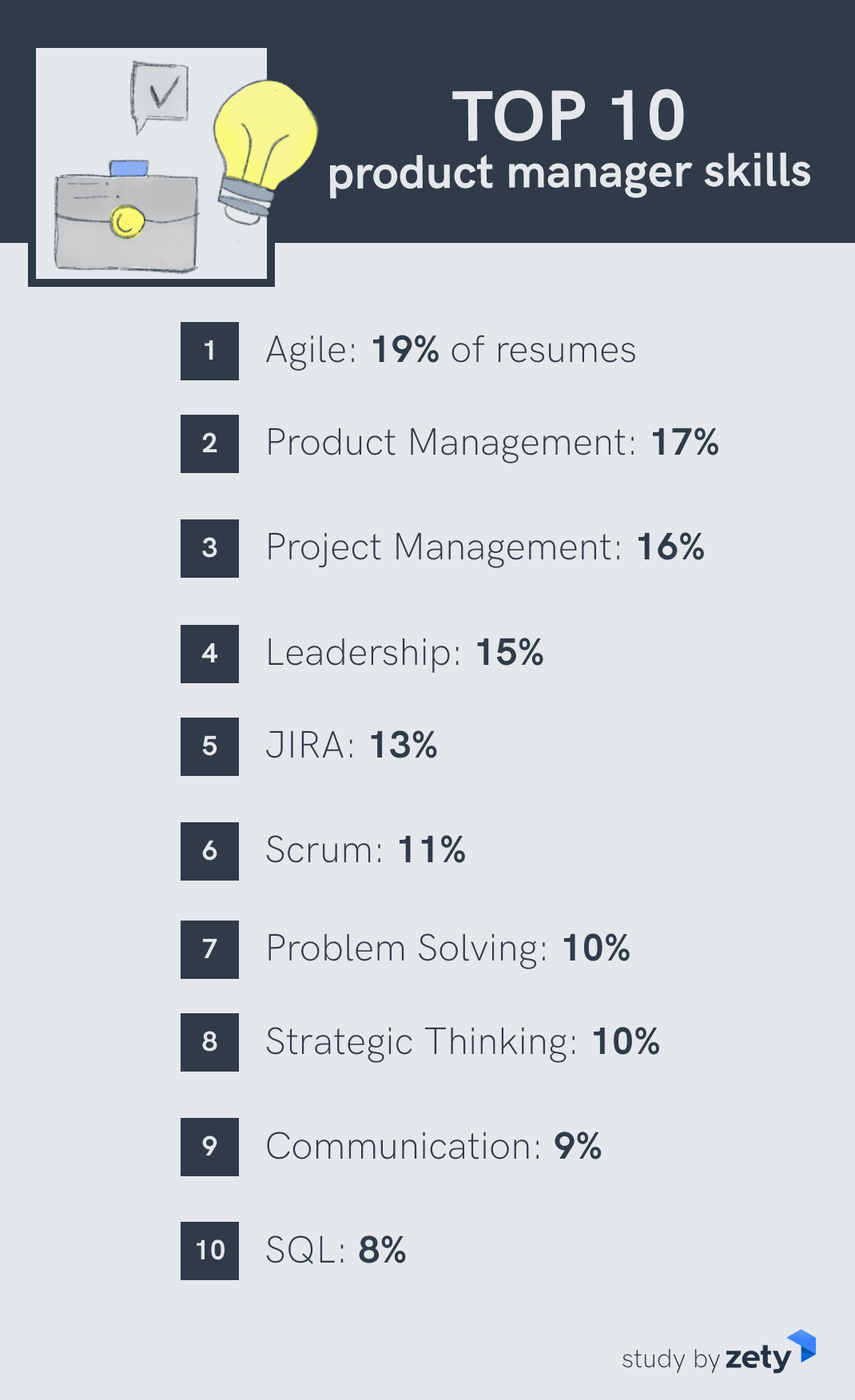
Top 15 most common skills
- Agile: 67 resumes (19%)
- Product Management: 57 (17%)
- Project Management: 55 (16%)
- Leadership: 52 (15%)
- JIRA: 44 (13%)
- Scrum: 37 (11%)
- Problem Solving: 36 (10%)
- Strategic Thinking: 34 (10%)
- Communication: 32 (9%)
- SQL: 30 (8%)
- User Experience: 28 (8%)
- Data Analysis: 26 (8%)
- Microsoft Office: 25 (7%)
- Google Analytics: 20 (6%)
- Product Strategy: 18 (5%)
Most important resume keywords: nouns, adjectives, verbs
Nouns
| Keyword rank | Single-word noun | Two-word compound noun |
| 1 | product | product management |
| 2 | management | project management |
| 3 | project | product development |
| 4 | team | Microsoft Office |
| 5 | business | data analysis |
| 6 | development | Google Analytics |
| 7 | customer | Agile methodology |
| 8 | analysis | product strategy |
| 9 | Agile | product owner |
| 10 | strategy | time management |
Adjectives
| Keyword rank | Single-word adjective | Two-word compound adjective |
| 1 | new | cross-functional |
| 2 | English | internal/external |
| 3 | technical | new technical |
| 4 | functional | data-driven |
| 5 | responsible | fast-paced |
| 6 | internal | responsible new |
| 7 | multiple | new user |
| 8 | various | functional technical |
| 9 | mobile | new internal |
| 10 | analytical | technical user |
Verbs
- testing
- including
- using
- working
- managed
- solving
- based
- leading
- created
- developed
Methodology and Limitations
For this study, we extracted data from over 2,000,000 resumes created with our resume builder. To keep the data more relevant, we limited the analysis to downloaded resumes only (assuming those were actually used in the job search). For the analysis of the most common entries, skills, and keywords, we further limited the sample to one document per user—leaving us with 133,289 resumes.The data for the most popular professions comes from documents in which a user’s job title exactly matches the job title discussed (i.e. for a given resume to be included in the “software engineer” resume analysis, the job title on the resume must read ���Software Engineer” with no permutations such as “Senior Software Engineer” etc.).
The data was collected anonymously. For non-discriminatory reasons, users’ age and gender was not disclosed in resumes. This limits a detailed demographic analysis.
The accuracy of the data regarding the most common skills and foreign languages is limited by users’ inconsistent spelling and phrasing. We tried to include all possible variations of skill descriptions (e.g. “MS Office” or “Microsoft Office”, as well as “Spanish” or “Spanish: Fluent,” etc.), but certain instances might have been omitted. The percentages denoting the most common skills and foreign languages listed by users might be underestimated by up to 0.5.
The data regarding the most contextually-relevant keywords (nouns, adjectives, and verbs) for particular professions has been extracted using the automated TF*IDF algorithm. Certain sets of compound words might not reflect the natural use of language since the TF*IDF algorithm has been programmed to ignore some of the most commonly used stop words (e.g. “or,” “a”,” “the,” “with,” etc.).
About Us
Zety analyzed thousands of resumes to help you choose the right resume format, write a resume summary, and select skills for your resume. Need job interview help? Learn how the STAR method can help you ace your interview.
About Zety’s Editorial Process
This article has been reviewed by our editorial team to make sure it follows Zety’s editorial guidelines. We’re committed to sharing our expertise and giving you trustworthy career advice tailored to your needs. High-quality content is what brings over 40 million readers to our site every year. But we don’t stop there. Our team conducts original research to understand the job market better, and we pride ourselves on being quoted by top universities and prime media outlets from around the world.

Follow Zety as a preferred source in Google
Get more resume writing tips, career insights, and workforce trends in your personalized search experience. Learn more >

Share:


